Hurom H400: Quick Verdict
- Best for
- People who want a self-feeding slow juicer and place a high priority on simpler cleanup.
- Standout feature
- Strainer-free Easy Cleaning Multi Auger system.
- Type
- Self-Feeding Slow Juicer · 90 RPM
Pros
- Easy Cleaning Multi Auger system
- No conventional fine-mesh strainer
- Self-feeding hopper
- Designed for family/batch juicing
- 150W A/C motor
- 90 RPM operation
- Relatively narrow 6.6-inch width
- Removable power cord
- 15-year warranty on motor and parts
- Nesting pulp container
Cons
- 18.5-inch height may matter under kitchen cabinets
- 14.8 lb is heavier than compact juicers such as the Nama J3
- Dedicated juicer with no blender functionality
- 90 RPM differs from some competing 50 RPM machines, although RPM alone does not determine juice quality
- Buyers who prefer conventional fine-mesh strainers may prefer another chamber design
- Sits in the premium slow-juicer category
Some links on this page are affiliate links. Affiliate disclosure.
What Makes the H400 "Easy Clean"?
Many conventional slow juicers use a fine-mesh strainer. It separates juice from pulp well, but its tiny holes can trap pulp and residue that usually need brushing out after each session.
The H400 takes a different approach. Hurom uses a two-part Easy Clean Multi Auger: an upper and lower auger that mesh together inside the chamber and perform the straining function without a conventional fine-mesh strainer. Hurom describes the H400 as part of its Easy Clean Series.
The individual components detach for rinsing. The design removes the conventional fine-mesh strainer from the cleanup process, which is the H400's main practical differentiator.
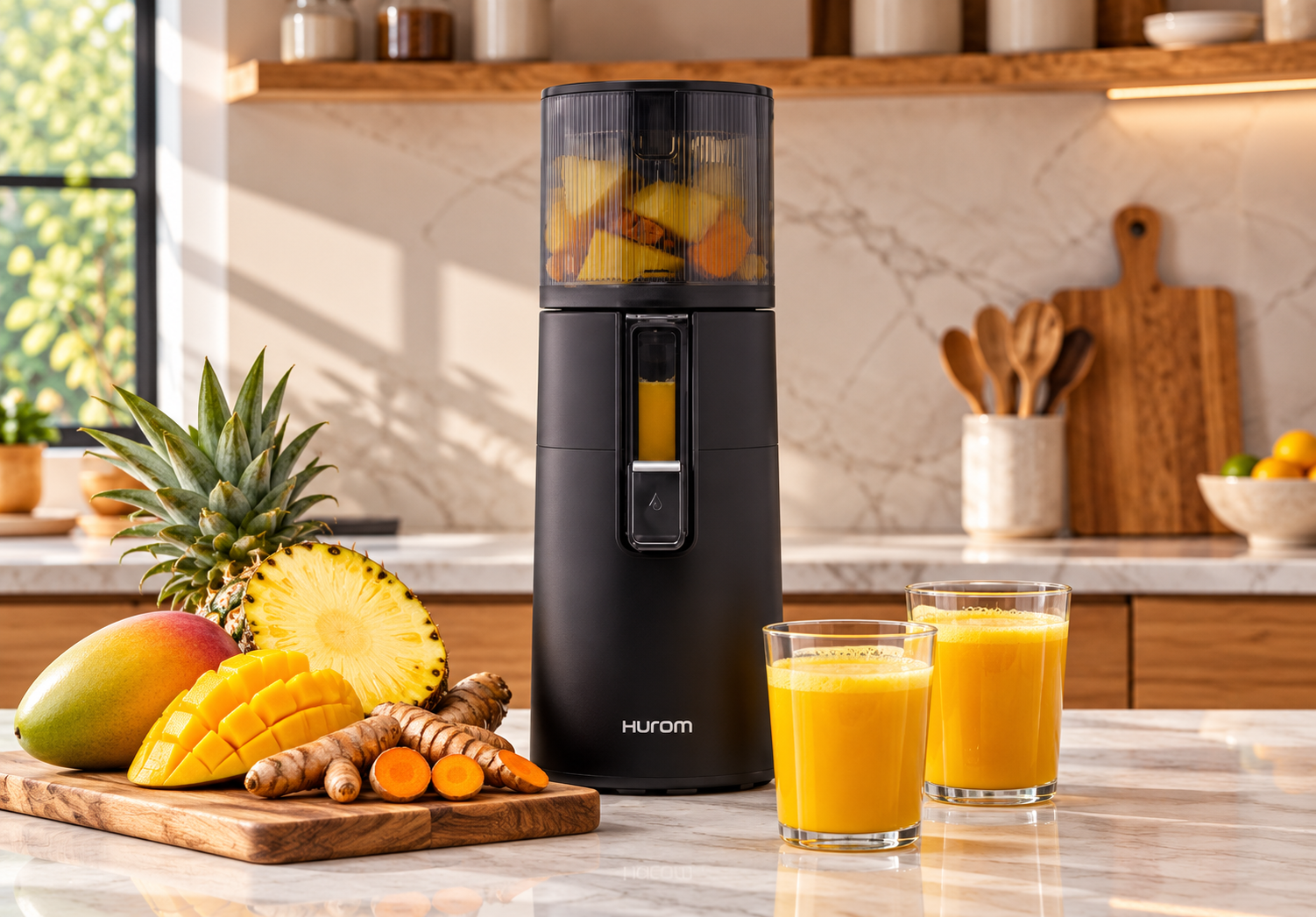
Key Features
Easy Cleaning Multi Auger
Two-part auger
An upper and lower auger mesh together to strain juice without a conventional fine-mesh strainer.
Self-feeding hopper
1.8 in chute
Load multiple ingredients into the hopper instead of feeding produce piece by piece.
Slow juicing
90 RPM · 150W
A 150W A/C motor drives the auger at 90 RPM.
Narrow footprint
6.6 in wide
Relatively narrow at 6.6 in, though tall at 18.5 in.
Long warranty
15 years
Hurom states a 15-year warranty on motor and parts.
Self-Feeding Batch Juicing
The H400 uses a large self-feeding hopper designed to let you load multiple ingredients at once rather than continuously feeding produce piece by piece. Hurom positions it for families, committed juicers and batch preparation.
Hurom doesn't publish a total hopper capacity in the specifications we use. The 550 ml / 18.6 oz figure is the chamber capacity — not necessarily the total hopper capacity.
H400 Juice Texture and Pulp
Hurom designed the two-part auger system to strain juice without a conventional fine-mesh strainer, and markets the H400 as producing low-pulp juice. That doesn't mean the juice is completely pulp-free, and we don't claim it produces less pulp than every competing machine.
If you're particularly sensitive to juice texture, it's worth understanding that straining systems differ between machines, and the H400's approach is different from a traditional fine-mesh strainer.
H400 Assembly
Hurom states that it streamlined the H400's internal juicing mechanism and reduced the number of pieces needed for assembly. The juicing section consists primarily of the chamber and the two-part auger system, rather than a traditional collection of fine and coarse mesh strainers.
How Big Is the Hurom H400?
The H400 measures 6.6 × 10.3 × 18.5 in and weighs 14.8 lb. It's relatively narrow at 6.6 inches wide, but at 18.5 inches tall it isn't compact overall.
If you have cabinets directly above your countertop, measure the vertical clearance before buying.
How the Hurom H400 Works
- 1
Prepare produce
Wash produce, remove large pits and cut larger items to fit.
- 2
Load the hopper
Add multiple ingredients to the self-feeding hopper.
- 3
Start the juicer
The two-part auger draws produce in at 90 RPM.
- 4
Juice & pulp separate
Juice and pulp exit into separate containers.
What Can You Juice with the H400?
Like other slow juicers, the H400 is designed for a wide range of fruit and vegetables — apples, carrots, celery, cucumber, citrus, ginger, leafy greens and beets are all typical slow-juicer ingredients.
Ingredient preparation may still be necessary depending on the produce's size, shape, seeds and hardness. Hurom specifically advises removing large pits, such as peach pits, before juicing.
Hard Produce
Carrots, apples, beets and ginger are common slow-juicer ingredients. Cut larger pieces so they fit the hopper and feed consistently.
Soft Produce
Citrus and softer fruits can be juiced; peel citrus and remove large pits and hard seeds first.
Leafy Greens & Stalks
Celery, cucumber and leafy greens are popular slow-juicer choices. Alternating greens with firmer produce is a common technique.
We don't publish our own yield measurements for the H400.
What Can You Juice?
Produce commonly used in cold press juicing:
Looking for a machine for specific ingredients? See our guides to the best juicer for celery and the best juicer for ginger.
Cleaning
Cleaning the Hurom H400
Cleanup is the reason most people look at the H400. Because there is no traditional fine-mesh strainer, there are fewer conventional mesh surfaces to brush.
The two-part auger separates, and the chamber components detach so they can be rinsed individually. Hurom includes a cleaning brush for areas that still need attention. We don't publish cleaning times, and how quickly any juicer cleans up depends on the ingredients and how soon you rinse it.
Cleaning tips
- No conventional fine-mesh strainer to scrub
- Upper and lower augers separate for rinsing
- Chamber components detach
- Cleaning brush included
- Rinse parts soon after juicing, before pulp dries
Hurom H400 Specifications
| Model | H400 Easy Clean Slow Juicer |
|---|---|
| Chamber type | Easy Cleaning Multi Auger |
| Chamber capacity | 550 ml / 18.6 oz |
| Auger speed | 90 RPM |
| Spinning brush | N/A |
| Power | 150W |
| Motor | A/C |
| Voltage | 120V / 60Hz |
| Dimensions | 6.6 × 10.3 × 18.5 in (169 × 261 × 471 mm) |
| Weight | 14.8 lb / 6.7 kg |
| Hopper chute opening | 1.8 in / 45 mm |
| Cord | 4.6 ft / 1.4 m, removable |
| Standard usage | Up to 30 minutes continuously |
| Warranty | 15 years on motor and parts |
Specifications are based on current information published by Hurom and may change.
Detailed specifications
Materials
- Body
- ABS
- Chamber
- Tritan
- Squeezing Screw
- Ultem
- Hopper
- ABS + MABS
Hurom states its juicers are BPA-free.
Product specifications sourced from Hurom's official H400 documentation.
What's Included
- Upper Auger
- Lower Auger
- Chamber
- Hopper
- Pusher
- Juice Container
- Pulp Container
- Power Cord
- Cleaning Brush
- Manual & Recipe Book
Hurom H400 Pros and Cons
Pros
- Easy Cleaning Multi Auger system
- No conventional fine-mesh strainer
- Self-feeding hopper
- Designed for family/batch juicing
- 150W A/C motor
- 90 RPM operation
- Relatively narrow 6.6-inch width
- Removable power cord
- 15-year warranty on motor and parts
- Nesting pulp container
Cons
- 18.5-inch height may matter under kitchen cabinets
- 14.8 lb is heavier than compact juicers such as the Nama J3
- Dedicated juicer with no blender functionality
- 90 RPM differs from some competing 50 RPM machines, although RPM alone does not determine juice quality
- Buyers who prefer conventional fine-mesh strainers may prefer another chamber design
- Sits in the premium slow-juicer category
Hurom H400 vs Nama J2
| Feature | Hurom H400 | Nama J2 |
|---|---|---|
| Type | Self-feeding slow juicer | Self-feeding cold press juicer |
| Power | 150W | 200W |
| Speed | 90 RPM | 50 RPM |
| Main differentiator | Easy Clean Multi Auger | Everyday self-feeding workflow |
| Conventional fine-mesh strainer | No | Uses Nama's juicing/strainer system |
| Dimensions | 6.6 × 10.3 × 18.5 in | 9.8 × 9.0 × 17.7 in |
| Weight | 14.8 lb | 12.1 lb |
| Warranty | 15 years motor + parts | 15 years |
| Best suited to | Cleanup-focused self-feeding juicing | Everyday/frequent juicing |
The H400's strongest distinction is its Easy Clean chamber design, while the J2's appeal centers on Nama's self-feeding everyday juicing workflow. Lower RPM does not automatically mean better juice.
H400 vs Nama J3
The H400 is the larger, heavier, batch-oriented machine, built around its Easy Clean system.
The Nama J3 measures 6.3 × 6.3 × 15.9 in, weighs 9.7 lb and has a 34 oz self-feeding hopper, designed for smaller batches and compact kitchens. Neither is better overall — they suit different kitchens and batch sizes.
Who Should Buy the Hurom H400?
You dislike cleaning mesh strainers
The H400 removes the conventional fine-mesh strainer from cleanup.
You want self-feeding
Load multiple ingredients instead of feeding piece by piece.
Families and batch juicers
Hurom positions the H400 for families and batch preparation.
Frequent juicers
Simpler cleanup matters more the more often you juice.
You value a long warranty
Hurom states 15 years on motor and parts.
You have vertical clearance
At 18.5 in tall, it needs room under cabinets.
Who May Prefer Something Else?
Check the Hurom H400
Prices change over time and vary by region and retailer, so we don't list a fixed price. Check the current retailer listing for the latest price of the H400.
Some links on this page are affiliate links. Affiliate disclosure.
Is the Hurom H400 Worth It?
The H400's main value is its Easy Cleaning Multi Auger: a two-part auger that strains juice without a conventional fine-mesh strainer, paired with a self-feeding hopper and a 15-year warranty on motor and parts.
It makes the most sense for people who juice often, want self-feeding batch juicing and put simpler cleanup high on their list — and who have the vertical clearance for an 18.5-inch machine. For more options, see our best juicers guide.
Some links on this page are affiliate links. Affiliate disclosure.
FAQs
What is the Hurom H400?
The Hurom H400 is a self-feeding slow juicer in Hurom's Easy Clean Series. It uses a two-part Easy Cleaning Multi Auger instead of a conventional fine-mesh strainer, runs at 90 RPM and has a 150W motor.
Is the Hurom H400 a cold press juicer?
Hurom calls the H400 a slow juicer. Slow juicers and cold press juicers both press produce at low speed rather than shredding it with a fast-spinning blade, and the terms are often used interchangeably.
What makes the Hurom H400 easy to clean?
It has no conventional fine-mesh strainer. A two-part auger performs the straining function, and the auger and chamber components detach for rinsing, leaving fewer mesh surfaces to brush. Hurom includes a cleaning brush.
Does the Hurom H400 have a mesh strainer?
No. The H400 uses Hurom's two-part Easy Cleaning Multi Auger to strain juice instead of a conventional fine-mesh strainer.
Is the Hurom H400 self-feeding?
Yes. The H400 has a self-feeding hopper designed to let you load multiple ingredients rather than feeding produce piece by piece.
What RPM is the Hurom H400?
Hurom lists the H400's auger speed as 90 RPM.
How powerful is the Hurom H400?
The H400 has a 150W A/C motor.
How big is the Hurom H400?
It measures 6.6 × 10.3 × 18.5 in (169 × 261 × 471 mm). It's relatively narrow but tall, so check the clearance under your cabinets.
How much does the Hurom H400 weigh?
The H400 weighs 14.8 lb (6.7 kg).
What is the H400 chamber capacity?
550 ml / 18.6 oz is the chamber capacity. This is not necessarily the total hopper capacity, which Hurom doesn't list in the specifications we use.
What warranty does the Hurom H400 have?
Hurom currently states that the motor and parts are covered by a 15-year warranty.
What is the difference between the Hurom H400 and Nama J2?
The H400 (150W, 90 RPM, 6.6 × 10.3 × 18.5 in, 14.8 lb) is built around its strainer-free Easy Clean Multi Auger. The Nama J2 (200W, 50 RPM, 9.8 × 9.0 × 17.7 in, 12.1 lb) centers on Nama's self-feeding everyday juicing workflow. Both have 15-year warranties; neither is better for everyone.
Related reviews & guides
- See our best juicers guide
- Nama J2 review
- Nama J3 review
- Nama J2 vs Hurom H400
- Hurom H70 review (more compact Easy Clean model)
- Hurom H70 vs H400 comparison
- How Hurom compares with Nama
- Our cold press juicer guide
Last updated: September 2026. Learn about our review process.