Juicer Comparison · Last updated September 2026
Nama J2 vs Hurom H70: What's the Difference?
Both are premium self-feeding slow juicers with long warranties, but their designs emphasize different things. The Nama J2 is built around a self-feeding everyday juicing workflow, while the Hurom H70 pairs self-feeding with Hurom's strainer-free Easy Cleaning Multi Auger.
Some links on this page are affiliate links. Affiliate disclosure.
This comparison is based on current manufacturer specifications and documented product design. We have not performed standardized side-by-side yield, cleaning-time or noise tests. How we review juicers.
The two juicers
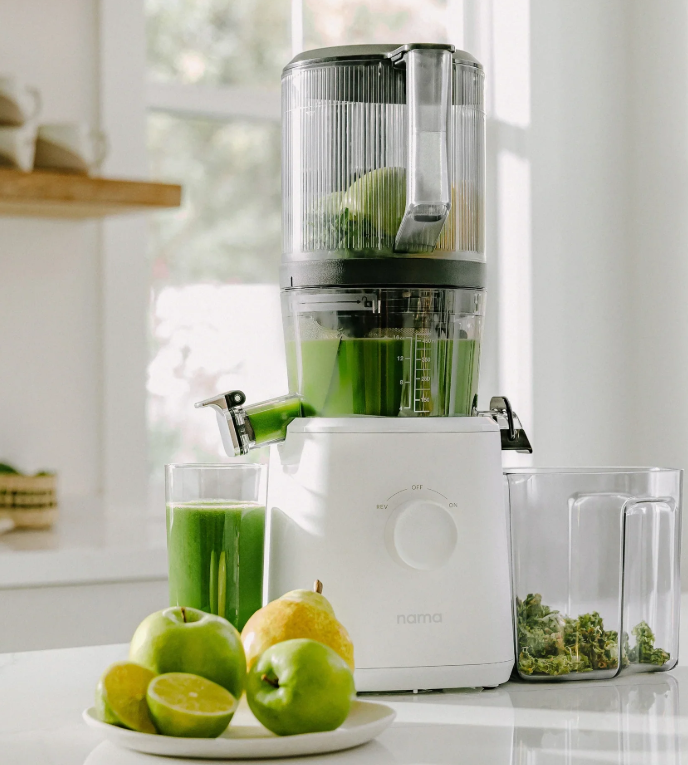
Nama J2
- 200W
- 50 RPM
- Self-feeding hopper
- 9.8 × 9.0 × 17.7 in
- 12.1 lb
- 15-year warranty
Save 10% with code MOH10
Check Price at NamaRead J2 Review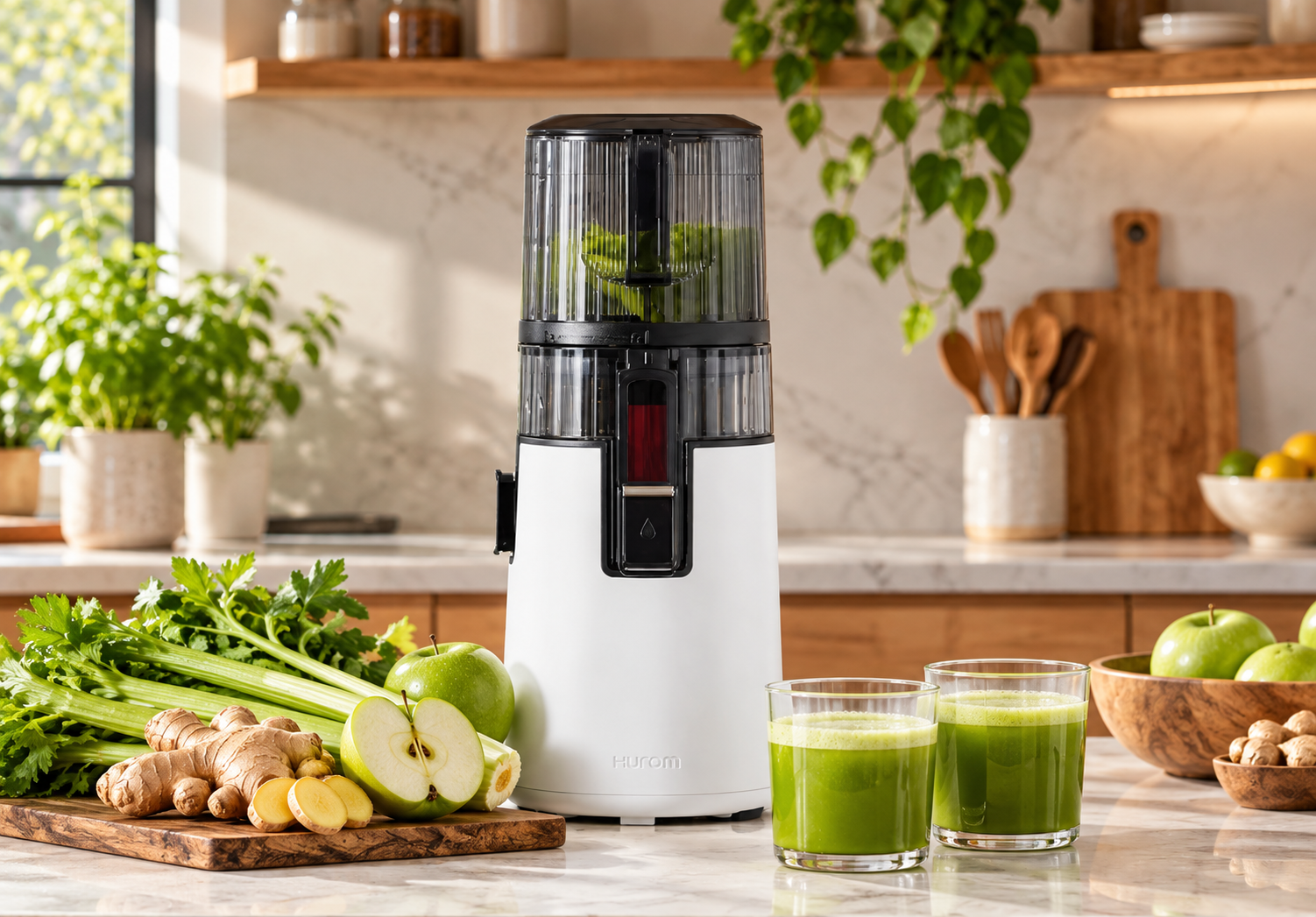
Hurom H70
- 150W AC motor
- 60/70 RPM
- Self-feeding hopper
- Easy Cleaning Multi Auger
- 450 ml / 15.2 oz chamber capacity
- 6.8 × 8.5 × 17.2 in
- 14.8 lb
- Up to 30 minutes continuous use
- 15-year motor-and-parts warranty
Nama J2 vs Hurom H70: The Short Answer
Both machines offer self-feeding workflows and 15-year warranty coverage, but their designs emphasize different priorities.
Consider the Nama J2 if:
- You want Nama's established self-feeding workflow
- You regularly prepare mixed fruit and vegetable juices
- You want the lighter machine of these two based on verified weights
- You prefer the Nama ecosystem
- You can use MOH10 for 10% off
Consider the Hurom H70 if:
- Cleanup design is a major priority
- You specifically want Hurom's Easy Cleaning Multi Auger
- You want a narrower verified footprint
- Up to 30 minutes continuous operation fits your routine
- You prefer Hurom's Easy Clean system
Nama J2 vs Hurom H70 Comparison
| Feature | Nama J2 | Hurom H70 |
|---|---|---|
| Type | Cold press / slow juicer | Cold press / slow juicer |
| Power | 200W | 150W |
| Motor | Single-phase induction | AC |
| Speed | 50 RPM | 60/70 RPM |
| Feeding | Self-feeding hopper | Self-feeding hopper |
| Chamber | — | 450 ml / 15.2 oz |
| Cleaning design | Removable chamber, auger, spinning brush; juice and coarse strainers | Easy Cleaning Multi Auger |
| Dimensions | 9.8 × 9.0 × 17.7 in | 6.8 × 8.5 × 17.2 in |
| Weight | 12.1 lb | 14.8 lb |
| Continuous use | — | Up to 30 minutes |
| Warranty | 15 years | 15 years on motor and parts |
| Promo | 10% off with MOH10 | — |
Specifications are based on current manufacturer information and may change.
Both Are Self-Feeding — So What's Different?
Unlike our Nama J2 vs REVO830 comparison, this isn't primarily a hopper-versus-chute decision. Both machines are designed around self-feeding: you load prepared ingredients and the machine progressively draws them in.
The more meaningful distinction is what happens after ingredients enter the machine — how each one's internal juicing and straining system is designed, and what that means for cleanup.
Nama J2 vs Hurom H70 for Cleaning
Hurom H70: Easy Cleaning Multi Auger
The H70 uses a two-part auger and a strainer-free chamber design rather than a conventional fine-mesh strainer. That matters because fine-mesh components can need attention when pulp and residue collect in their small openings. Hurom's approach integrates the straining function into the chamber and auger system instead.
Nama J2: removable chamber and strainers
Nama designed the J2 so its juicing components can be disassembled for cleaning, and a cleaning brush is included. The parts that touch produce — hopper, chamber, auger, strainers and spinning brush — are removable. It comes with both a juice strainer and a coarse strainer.
The H70's internal design is more explicitly centered around reducing fine-mesh strainer cleaning.
We haven't measured cleaning times for either machine, and real-world cleanup still depends on the produce, fibrous residue and your routine. For the H400, which uses the same Easy Clean concept, see our Hurom H400 review.
200W vs 150W: Does Motor Power Decide It?
200W
150W
The J2 has the higher rated wattage. However, wattage alone does not establish:
- Juice yield
- Juice quality
- Nutrient retention
- Reliability
- Clog resistance
These machines use different internal systems, so 50W more on paper doesn't make the J2 the better juicer.
50 RPM vs 60/70 RPM
50 RPM
60/70 RPM
Both operate at relatively low rotational speeds compared with centrifugal juicers. A lower RPM does not automatically produce better juice — machine architecture matters more than comparing these numbers in isolation.
Which Takes Up Less Counter Space?
9.8 × 9.0 × 17.7 in
6.8 × 8.5 × 17.2 in
Based on the manufacturers' listed dimensions, the H70 is:
- Narrower
- Slightly shallower
- Slightly shorter
That's useful if counter space or cabinet clearance is tight, but it doesn't make the H70 the better machine overall.
Weight
12.1 lb
14.8 lb
The J2 is approximately 2.7 lb lighter — a simple calculation from the manufacturer-listed weights. Lighter isn't automatically better; it mainly matters if you move the machine in and out of storage often.
What About Batch Juicing?
Hurom describes the H70 as suitable for batch juicing and lists up to 30 minutes of continuous use. The J2's self-feeding hopper is designed to let you load prepared produce in batches rather than feeding continuously; we don't list a continuous runtime for the J2 because it isn't verified for this guide.
Hopper size isn't the only consideration. Your workflow, recipe size and how often the machine needs refilling all matter. We don't compare hopper capacities because they aren't verified for both machines.
Nama J2 vs Hurom H70 for Celery
Celery is long, fibrous and stringy. Both self-feeding designs can fit celery-based recipes when produce is prepared according to manufacturer guidance. Neither is proven to deliver a higher celery yield.
If you specifically want a dedicated long-produce feeding approach, the Kuvings REVO830 is an alternative worth a look.
See Our Celery Juicer GuideNama J2 vs Hurom H70 for Ginger
Ginger is dense, fibrous and irregularly shaped. Both machines can fit recipes combining ginger with other produce: the J2 through its self-feeding mixed-recipe workflow, the H70 through self-feeding plus its Easy Clean chamber design. We don't claim either extracts more ginger juice.
See Our Ginger Juicer GuideWhich Makes More Sense for Everyday Mixed Juices?
Because both machines are self-feeding, this is a closer comparison than the J2 versus a traditional direct-feed machine. The decision comes down more to:
- Cleaning design
- Physical size
- Weight
- Continuous-use needs
- Preferred ecosystem
- Warranty details
- Personal workflow
There's no universal winner.
Warranty
Nama J2
15-year warranty
Hurom H70
15 years on motor and parts
Warranty details and eligibility can depend on manufacturer terms, market and purchase conditions. Check Nama's and Hurom's current warranty terms before buying.
Nama J2 Discount
Save 10% with code MOH10
Promotional affiliate code. Terms may change without notice.
Other Juicers to Consider
Hurom H400
For people who want the larger Hurom Easy Clean option already covered on BestSlowJuicer.
Nama J2 vs Hurom H70 FAQ
What is the main difference between the Nama J2 and Hurom H70?
Both are self-feeding slow juicers with 15-year warranty coverage. The main difference is internal design: the J2 uses a chamber with removable juice and coarse strainers, while the H70 uses Hurom's Easy Cleaning Multi Auger, a two-part auger with a strainer-free chamber design.
Are both the Nama J2 and Hurom H70 self-feeding?
Yes. Both use a self-feeding hopper, so this is not a hopper-versus-chute decision. The distinction is what happens inside: the J2 uses conventional strainers, while the H70 integrates the straining function into its chamber and auger system.
Which has the more powerful motor?
The Nama J2 is rated at 200W and the Hurom H70 at 150W. Wattage alone doesn't establish better yield, juice quality, reliability or clog resistance, because the machines use different internal systems.
Which runs at a lower RPM?
The Nama J2 is listed at 50 RPM and the Hurom H70 at 60/70 RPM. Both are low speeds compared with centrifugal juicers, and a lower number does not automatically mean better juice.
Which is smaller?
Based on listed dimensions, the Hurom H70 (6.8 × 8.5 × 17.2 in) is narrower, slightly shallower and slightly shorter than the Nama J2 (9.8 × 9.0 × 17.7 in).
Which is lighter?
The Nama J2 is listed at 12.1 lb and the Hurom H70 at 14.8 lb, so the J2 is about 2.7 lb lighter based on manufacturer-listed weights.
Which is easier to clean?
The H70's Easy Cleaning Multi Auger is designed around reducing fine-mesh strainer cleaning, which the J2's conventional strainers still involve. However, we haven't performed standardized side-by-side cleaning-time tests, and cleanup also depends on the produce and your routine.
Which is better for celery?
Neither is proven better. Both self-feeding designs can fit celery recipes when celery is prepared according to manufacturer guidance, such as cutting stalks to reduce stringy fibers wrapping. See our best juicer for celery guide.
Which is better for ginger?
Neither is proven to extract more. Both can handle recipes combining ginger with other produce; the J2 offers Nama's self-feeding mixed-recipe workflow and the H70 adds its Easy Clean chamber design. See our best juicer for ginger guide.
How long can the Hurom H70 run continuously?
Hurom lists up to 30 minutes of standard continuous use for the H70.
What warranty does the Hurom H70 have?
According to Hurom's current U.S. product page, the H70 has a 15-year warranty on motor and parts. Terms can vary by market and purchase conditions.
What warranty does the Nama J2 have?
Nama lists a 15-year warranty for the new J2. Terms can vary by market and purchase conditions.
Is there a Nama J2 discount code?
Yes. Code MOH10 gives 10% off eligible Nama purchases, including the J2. Promotion terms may change.
Should I choose the Nama J2 or Hurom H70?
Consider the J2 if you want Nama's self-feeding workflow, a lighter machine, the Nama ecosystem and code MOH10. Consider the H70 if a strainer-free Easy Clean design, a narrower footprint and up to 30 minutes of continuous use matter more. There's no universal winner.